- 10/2011: Congratulations to Dr. Chris Hamley for the 2012 Amelio Award for Excellence in Resarch in the School of Physics.
- 10/2011: Congratulations to Dr. Chris Hamley for successfully defending his thesis (finally!).
- 12/2010: Congratulations to Dr. Michael Gibbons for successfully defending his thesis.
- 11/2010: Congratulations to Dr. Eva M. Bookjans for successfully defending his thesis.
- 07/2010: Congratulations to Dr. Layne Churchill for successfully defending his thesis.
Welcome to the webpage of Prof. Michael Chapman's research group at the School of Physics at the Georgia Institute of Technology (Georgia Tech) in Atlanta, Georgia.
Our research is focused on investigating the quantum behavior of atoms and photons, often at the single particle level. We employ lasers to confine and cool atoms to nano-Kelvin temperatures,
which are used for studies including fundamental atom-photon interactions, atom optics and interferometry, and quantum computing and communication.
Recent achievements include the first all-optical Bose-Einstein condensation (BEC), the first storage ring for neutral atoms, and cavity QED with optically transported ultracold atoms.
|
Squeezing in Spinor Bose-Einstein Condensates
The primary goal of this research is to utilize ferromagnetic spinor condensates to generate spin squeezed states and to investigate their applications to enhanced quantum metrology. This research will probe the relatively unexplored system size scale of <1000 atoms where complete quantum calculations are a challenge and mean-field theoretical approaches break down. There is much interest in explorations beyond the mean field approximation and, in particular, in the creation and detection of nonclassical, quantum correlated states of the atomic fields. |
|
First All-Optical Formation of an Atomic Bose-Einstein Condensate
We have created a Bose-Einstein condensate (BEC) of 87Rb atoms directly in an optical trap. We employ a quasielectrostatic dipole force trap formed by two crossed CO2 laser beams. Loading directly from a sub-Doppler laser-cooled cloud of atoms results in initial phase space densities of ~1/200. Evaporatively cooling through the BEC transition is achieved by lowering the power in the trapping beams over ~2s. The resulting condensates are F = 1 spinors with 3.5×10⁴ atoms distributed between the mF = (-1,0,1) states. |
|
Robust Neutral Atom Qubits
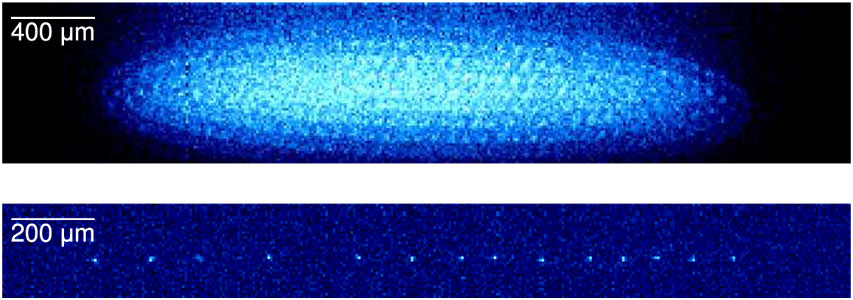
The primary objective of this proposal is to develop non-destructive, or lossless, quantum state detection methods for single trapped neutral atoms in order to realize robust neutral atom qubits. This work will directly address an important limitation in neutral atom qubit experiments, which is that quantum state detection of single atoms results in the loss of the qubit from the trap. This research will lead to a 1000-fold increase in experimental efficiency for neutral atoms systems and enable exciting new developments in the field of quantum information. |
|
Single Atom Experiment
Neutral atoms are one of the most promising systems for quantum information. In order to achieve atom trap lifetimes greater than 10 s, far-off resonant trap (FORT) depths on the order of milli-Kelvin are required. Unfortunately, FORTs operating in this regime also induce excited state AC stark shifts that compromise laser cooling and coherent control of the optical transitions. A major goal of this research is to investigate the detailed level shifts under these circumstances. We investigate the behavior of single 87Rb atoms in a FORT operating at 1064 nm. The Zeeman state dependent AC Stark shift of the atomic energy levels depend strongly to the polarization of the trap beam. We directly measure the AC Stark shifted spectrum of single atoms and compare to theoretical predictions. Additionally, we perform temperature measurements of individually trapped single atoms that provide useful information to the study of heating and loss mechanism in the probe process. |
|
Laser excitation of the 229Th nuclear isomer
We propose to apply AMO technologies of ion trapping and cooling and high resolution spectroscopy to the manipulation of a nuclear excited state. The subject of this research is the thorium-229 isotope, which, uniquely, has an excited state in the UV optical spectrum. |